
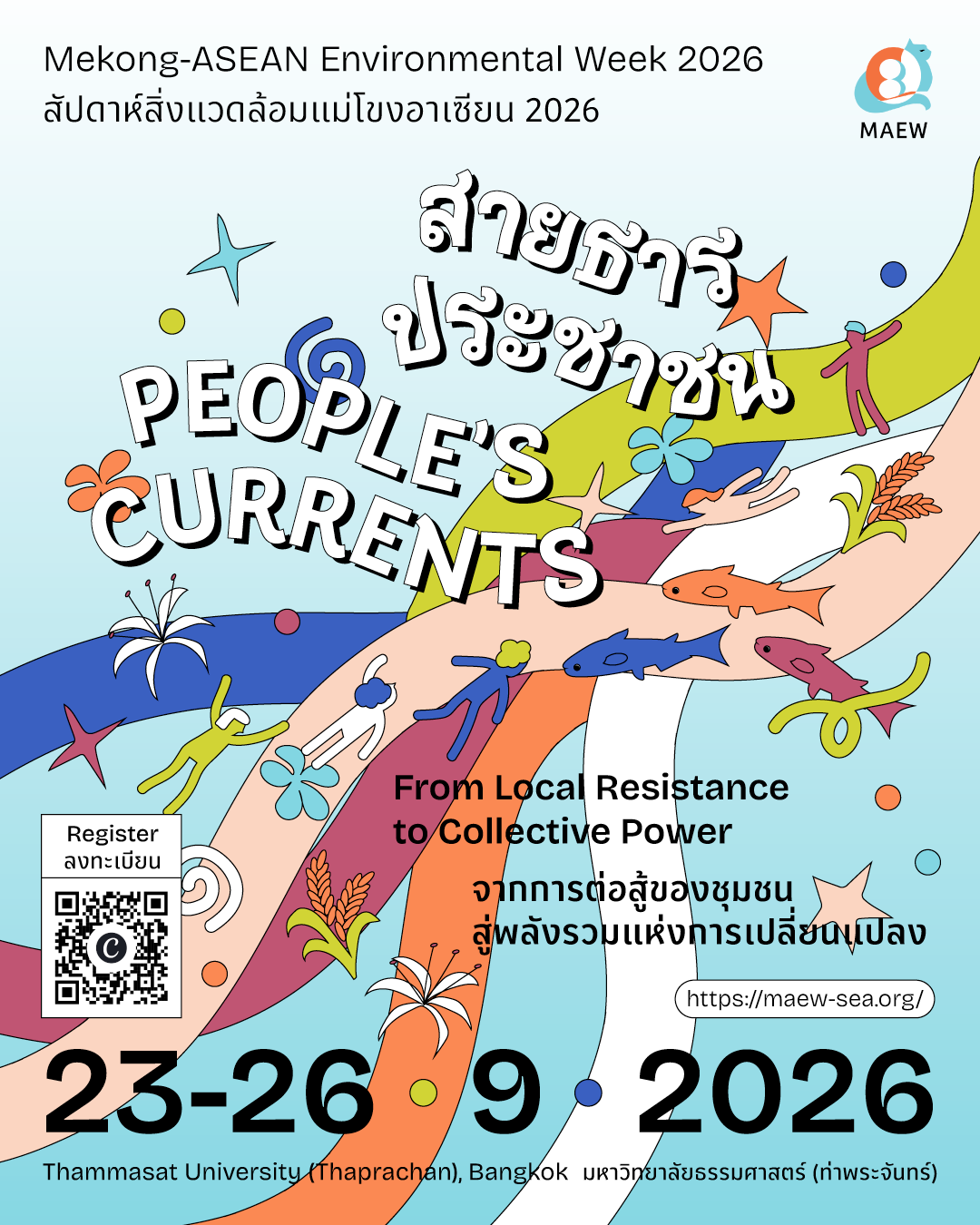
The Mekong–ASEAN Environmental Week (MAEW) is a regional platform for public exchange among civil society networks, diverse communities, academics, artists, youth, and social movements working across the Mekong region and Southeast Asia. Initiated by Project SEVANA Southeast Asia in 2019, MAEW has grown into an annual gathering that creates space for dialogue, learning, cultural exchange, and collective action around environmental justice and interconnected social issues.
The Mekong–ASEAN Environmental Week (MAEW) is a regional platform for public exchange among civil society networks, diverse communities, academics, artists, youth, and social movements working across the Mekong region and Southeast Asia. Initiated by Project SEVANA Southeast Asia in 2019, MAEW has grown into an annual gathering that creates space for dialogue, learning, cultural exchange, and collective action around environmental justice and interconnected social issues.
Events
Filter Events
{{ filteredEventsForView.length }} Events
Filter Events
{{ filteredEventsForView.length }} Events
At Riverside Meeting Room (107–108), Faculty of Liberal Arts
[by Ubon Monitoring Group on Flood and Dams, Laos Dam Investment Monitor]
Thirty-six years after the construction of Pak Mun Dam, communities continue to fight for ecological restoration, the permanent opening of the dam gates, and justice for affected people. Their long struggle has become one of the Mekong region’s most important environmental justice movements.
This session uses the Pak Mun experience as a starting point to reflect on the continuing expansion of hydropower across the Mekong and Southeast Asia. Bringing together community leaders, researchers, and regional movements, the discussion connects lessons from Pak Mun with Nam Theun 2 and Phou Ngoy in Laos, and with new large-scale hydropower development in Indonesia, including Mentarang in North Kalimantan and the proposed dam complex in the Mamberamo River in Papua. The session asks why lessons from past dam projects continue to be ignored, and how communities and movements across the region can strengthen collaboration to defend rivers, territories, livelihoods, and community rights.
Opening Documentary Screening
A short documentary introducing the history of Pak Mun Dam and the communities’ long struggle for river restoration.
Session I: Lessons from Pak Mun: River Restoration, Fisheries, Livelihoods, and New Research
Speakers:
Sompong Viengchan, Pak Mun community representative
Sodsai Sarangsok, Ubon Monitoring Group on Flood and Dams (UMFD) / Researcher
Session II: From Pak Mun to Nam Theun 2 and Phou Ngoy: Why Have the Lessons Not Been Learned?
Speakers:
Civil society representative working on Nam Theun 2 and Phou Ngoy (TBC)
Researcher on the World Bank’s role in Pak Mun and Nam Theun 2 (TBC)
Session III: Beyond the Mekong: The Expansion of Large Dams in Southeast Asia
Dr. Hendro Sangkoyo (Yoyok), School of Democratic Economics, Indonesia Mentarang and Mamberamo: The Expansion of Large-Scale Hydropower in Indonesia
Experiences from North Kalimantan and Papua, examining the Mentarang hydropower project and proposed large-scale dam development on the Mamberamo River, their impacts on communities and territories, and what these projects reveal about the continuing expansion of hydropower development in Southeast Asia.
Leticia GOMES DE FARIA, Representatives from the Movement of People Affected by Dams (MAB and MAR), Latin America
Experiences of resistance to dams and defense of rivers and territories from Latin America.
Open Dialogue: The Future of Rivers: Community Rights and Regional Solidarity
An open discussion with speakers and participants on lessons across regions and possibilities for strengthening collaboration among communities and movements defending rivers and territories.
At Main Meeting Room, 4th Floor, Faculty of Sociology and Anthropology
[by Environmental Justice Foundation]
The activity presents stories of fishing communities and people affected by marine environmental problems along Thailand's Andaman coast through documentary films and photography. The works highlight the roles and key demands of communities in addressing and managing environmental issues affecting their own areas.
Through these works, EJF uses media to communicate issues of environmental and climate justice and bring the voices and experiences of affected communities to wider audiences.
A screening of five documentary films on marine environmental issues, each approximately 7–9 minutes, with a total screening time of approximately 45 minutes.
At Lecture Rooms 1–2, 6th Floor, Multipurpose Building 1, Puey Ungphakorn School of Development Studies
[by EarthRights International and EarthRights Alumni Network]
This panel brings together women environmental defenders from Thailand and Lao PDR to share their experiences working on land rights, dams, mining, energy projects, and climate change. Through a moderated discussion, the session explores how gender shapes environmental and human rights advocacy, the challenges women face, and the important roles they play in building community trust, strengthening solidarity, and advancing environmental justice.
The panel features four women environmental defenders—three from Thailand and one from Lao PDR—who will share their experiences working on land rights, dams, mining, energy projects, and climate change. Through a moderated discussion, the session explores how gender shapes environmental and human rights advocacy, the challenges women face, and the perspectives they bring to community engagement and collective action.
At Riverside Meeting Room (107–108), Faculty of Liberal Arts
[by Radical Grandma Collective, Restorative Culture Coalition Thailand, Community Weaving School Network, Loei Province, Hom Dok Hung Rice Agroecology Network, Sakon Nakhon Province, Project SEVANA South-East Asia)]
This activity creates a space for dialogue, storytelling, and practical workshops exploring how communities across the Mekong region are responding to ecological degradation, extractive industries, toxic contamination, and social fragmentation through community-led restoration practices.
Bringing together community leaders, artists, researchers, and grassroots movements, the session highlights how frontline communities are restoring ecosystems, relationships, health, culture, and dignity through collective action, while imagining restorative futures for the Mekong region.
The activity will include:
Opening: Healing the Mekong Dialogue by Premrudee Daoroung, Project SEVANA South-East Asia
Visual presentation: The Wounds of the Mekong River by Pairin Sohsai, River and Rights
followed by three dialogue sessions:
Session 1: Stories from the Frontlines
Chalalai Nasuan, Lower Klity Community, Kanchanaburi — Lessons from intergenerational lead pollution and restoration
Pattarapon Kaengchampa, Khon Rak Ban Kerd Group, Loei — Restoring communities affected by gold mining pollution
Session 2: Healing Dialogue: From Resistance to Healing and Restoration
Rasi Salai Dam — Community representative
Ecological restoration — Kanokwan Manorom
Alternative agriculture: Hom Dok Hang indigenous rice project
Health and restoration — Kitima Khunthong
Pollution and mining — Rojana Kongsan, Khon Rak Ban Kerd Group
Social and political dimensions of restoration — Becky Goncharoff
Session 3 — Initiating Healing and Restoration: Healing Us, Healing the Mekong
A participatory activity inviting participants to explore what needs to be restored, the strengths and resources already present in different communities, and what the network can collectively advance.
The dialogue will conclude with “People’s Declaration.”
(Speakers to be confirmed.).
Main Meeting Room, 4th Floor, Faculty of Sociology and Anthropology
[by Phanom Nakhon Rama, DeCode]
The Mekong-ASEAN Documentary Film Week 2026 uses documentary films, animations, and post-screening dialogues to create spaces for learning, reflection, and exchange among filmmakers, affected communities, and audiences. Each day's program explores a different theme while contributing to the broader vision of People's Currents, highlighting how stories from communities can inspire understanding, solidarity, and collective action. At least one screening will feature films produced through the Mekong Youth Lab, showcasing young people's perspectives and stories from across the region.
At Lecture Rooms 1–2, 6th Floor, Multipurpose Building 1, Puey Ungphakorn School of Development Studies
[by The Mekong Butterfly]
The Mekong River Basin is one of the world's richest food-producing landscapes, where rivers, forests, and local communities have long sustained diverse food cultures and livelihoods. Today, however, hydropower dams, mining, transboundary pollution, and large-scale development are transforming these interconnected ecosystems, threatening fisheries, agriculture, food security, and community wellbeing across the region.
Through stories of food, memory, and everyday life, this session reflects on what has been lost, what remains, and how communities are adapting, restoring local food systems, and defending their right to food, healthy ecosystems, and traditional ways of life.
Speakers:
--- Wanisa Nangrongsri (The Mekong Butterfly)
--- Chanang Amparak (The Mekong Butterfly)
--- Nutsuda Pansap (Modular Team, Project SEVANA Southeast Asia)
[Additional speakers to be confirmed.]
At Riverside Meeting Room (107–108), Faculty of Liberal Arts
The second day of MAEW is dedicated to the voices of communities defending rivers, forests, land, food systems, and people's rights. Through their experiences, participants are reminded that knowledge is not produced only in universities or policy spaces, but also through lived experience, collective action, and everyday struggles. This closing reflection invites participants to consider the lessons they have learned from frontline communities and the stories that will continue to shape their own work.
At Pridi Banomyong Courtyard
This activity will be in Thai.
A casual discussion group in Thai, limited to 10 people. (Registration is open via ggform; we will contact you by phone to confirm your participation.)
The purpose is to study and exchange anecdotes about environmental history in Thailand between generations before it is forgotten.
The Committee for the Conservation of Natural Resources and the Environment (CONE) was a network of students from 16 institutions who came together to mobilize and campaign for environmental protection in Thailand during the years 1978-2002, following the October political events. They played a crucial role in opposing the Nam Choen Dam project. Today, many former CONE students have grown up to become influential figures in the environmental field in various roles.
*At Pridi Banomyong Courtyard
[by Alternative Agriculture Network (AAN), AgroEcology Foundation, Sustainable Agriculture Foundation Thailand, Food for Change, Towards Organic Asia (TOA), Project SEVANA South-East Asia]
Food systems are more than food production. They are deeply connected to biodiversity, farmers' rights, local knowledge, and community stewardship of natural resources. Across Thailand and the Mekong region, communities continue to protect traditional food systems and local seed diversity while responding to the challenges of climate change, development policies, agricultural technologies, and trade agreements.
The People's Food Sovereignty Market creates a learning space throughout MAEW 2026, bringing together farmers, community networks, consumers, and visitors through local food, seeds, stories, and diverse food cultures. The market demonstrates how food sovereignty is rooted in community knowledge, biodiversity, and people's collective management of land and natural resources.
The People's Food Sovereignty Market will be open throughout MAEW 2026 as both a community marketplace and the main dining space for participants. Meals will be prepared and served by participating community networks, allowing participants to experience diverse local food traditions from across Thailand and the Mekong region. A meal coupon system will enable participants to choose food from different community stalls, encouraging interaction with local producers while supporting community-led food systems.
The market also includes a range of interactive learning activities:
People's Food Market – Local food, seeds, agricultural products, and community-made goods accompanied by stories from participating communities.
Food Ecology Mapping – A collaborative display highlighting local food systems, seed diversity, and community resource management across Thailand and the Mekong region.
Learning Market – Food demonstrations, ingredient sharing, storytelling, and informal learning activities with participating communities.
Market Talks – Informal conversations featuring community representatives from different regions, including Northern Thailand, Northeastern Thailand, Eastern Thailand, Central Thailand, Southern Thailand, and the Mekong region, sharing experiences on local food systems, biodiversity, and community resource management.
Through these activities, the People's Food Sovereignty Market provides a space for farmers, community leaders, researchers, civil society networks, and MAEW participants to exchange knowledge, strengthen collaboration, and explore community-led approaches to protecting food systems, biodiversity, and food sovereignty.
Stay up to date
Get occasional email updates from MAEW 2026. Nothing else, and you can stop any time.
At most one email every few days, only when there is something new. The schedule will see the name and email you enter here. We never sell or share them, and every email has an unsubscribe link. Privacy Policy
Confirming also sets up an account for you, so everything you follow is in one place.