
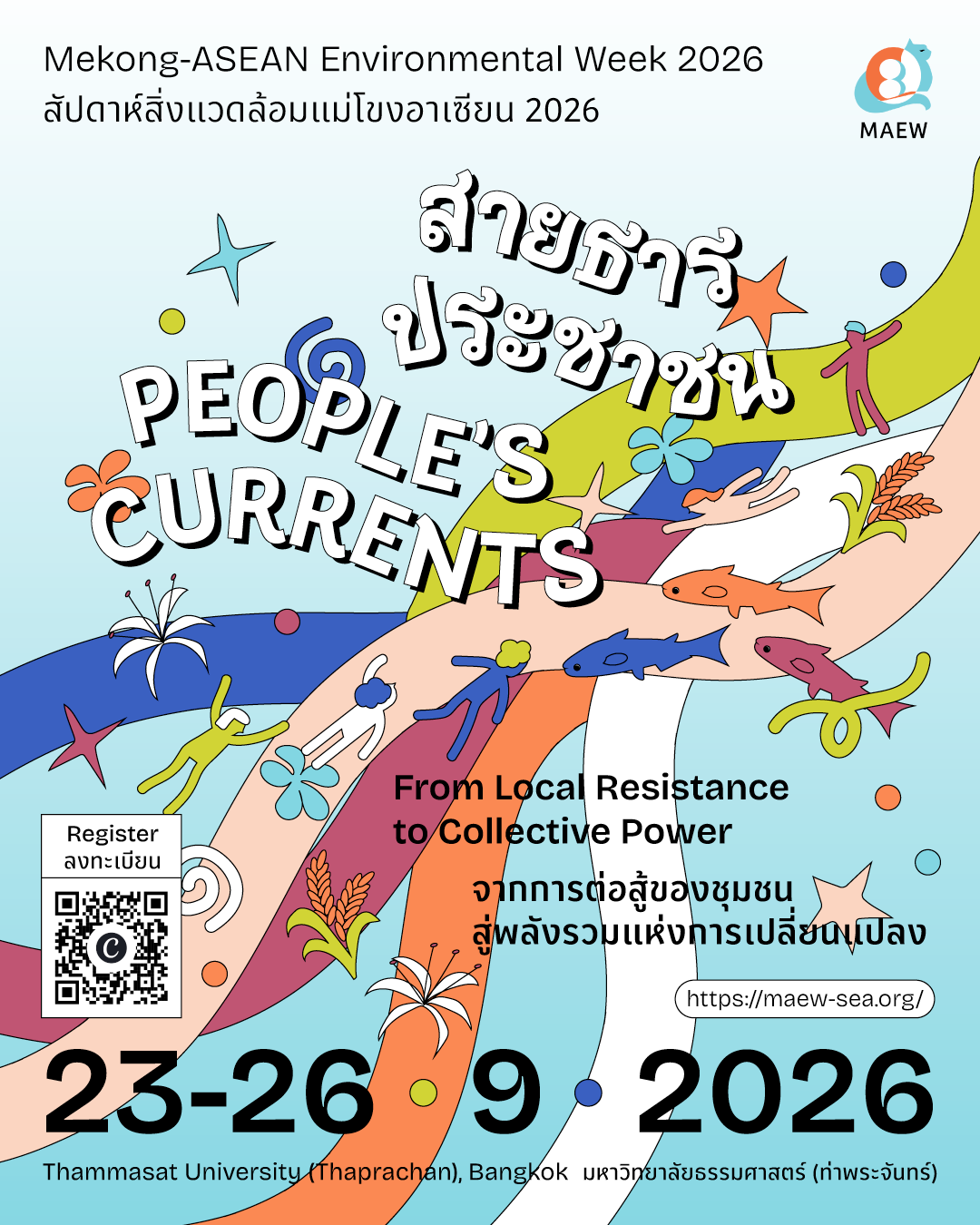
The Mekong–ASEAN Environmental Week (MAEW) is a regional platform for public exchange among civil society networks, diverse communities, academics, artists, youth, and social movements working across the Mekong region and Southeast Asia. Initiated by Project SEVANA Southeast Asia in 2019, MAEW has grown into an annual gathering that creates space for dialogue, learning, cultural exchange, and collective action around environmental justice and interconnected social issues.
The Mekong–ASEAN Environmental Week (MAEW) is a regional platform for public exchange among civil society networks, diverse communities, academics, artists, youth, and social movements working across the Mekong region and Southeast Asia. Initiated by Project SEVANA Southeast Asia in 2019, MAEW has grown into an annual gathering that creates space for dialogue, learning, cultural exchange, and collective action around environmental justice and interconnected social issues.
Events
Filter Events
{{ filteredEventsForView.length }} Events
Filter Events
{{ filteredEventsForView.length }} Events
At Riverside Meeting Room (107–108), Faculty of Liberal Arts
[by World Rainforest Movement,Project SEVANA South-East Asia]
This session explores carbon projects: what they are, why they are expanding across the Mekong region and globally, and how they are linked with agriculture, mining, dams, and energy projects. Drawing on community experiences from the Mekong and other regions, the discussion will examine the political economy behind the expansion of carbon markets, their impacts on land, forests, and community rights, and the concerns and responses emerging from affected communities.
The session will connect global trends with developments in the Mekong region while keeping community experiences at the center of the discussion. Presentations will be followed by an open exchange with participants.
Winnie Overbeek, World Rainforest Movement (WRM)
The Political Economy and Global Expansion of Carbon Markets and the Links with Dams, Mining, Agriculture and Energy Projects
An overview of the political economy behind carbon markets, their global expansion, and their connections with dams, mining, agriculture, energy, and other forms of resource extraction and development.
Phru Odochao, Karen community leader and Indigenous land and forest rights advocate, Northern Thailand
Living with the Forest: Karen Knowledge, Community Rights, and the Carbon Question
Drawing on Karen experiences of living with and caring for forests, Phru will share community perspectives on land and forest rights and raise questions about what happens when forests and community territories become part of carbon projects.
Carolina Motoki, World Rainforest Movement (WRM)
Community Experiences from Different Regions: Impacts of Carbon Projects on Land, Forests and Community Rights
Experiences from different regions illustrating how carbon projects affect communities, territories, forests, and rights, and how communities are responding.
At Lecture Rooms 1–2, 6th Floor, Multipurpose Building 1, Puey Ungphakorn School of Development Studies
[by EarthRights International and EarthRights Alumni Network]
Youth movements play an increasingly important role in responding to environmental challenges and strengthening people-led movements in Thailand and Lao PDR. This panel brings together young environmental advocates from both countries to share their experiences, reflect on environmental issues affecting their communities, and explore how youth can build stronger networks, promote meaningful participation, and contribute to a more just future for the Mekong region.
The panel features six youth representatives; three from Thailand and three from Lao PDR, in a moderated discussion on environmental challenges, youth participation, and engaging future generations in environmental action. The session concludes with an open dialogue between participants and the panelists.
At Room JM402, Faculty of Journalism and Mass Communication
[by Mekong Youth Lab, Mekong Field Lab, Project SEVANA South-East Asia]
Mekong Youth Lab (MYL) is a creative learning platform for young people across the Mekong region, encouraging them to learn from communities through field-based research, collaboration, and storytelling. In 2026, participants explored the theme "The Disappearing Food of the Mekong", examining how changes to rivers are transforming food systems, ecosystems, cultures, and community life.
Over several months, youth participants worked closely with communities to develop creative projects that communicate local experiences through documentary films and other artistic media. This showcase celebrates young people's voices and demonstrates how learning can become collective action for the future of the Mekong.
The program features five documentary films produced by five university teams, followed by conversations between youth filmmakers, community representatives, and participants.
The screenings create opportunities for dialogue, learning, and networking while highlighting young people's perspectives on environmental and social issues across the Mekong region.
Tai Ok Bab Palitaphan Team, Udon Thani Rajabhat University (Product Design Program)
Pab Mai Ning Team, Vongchavalitkul University (Faculty of Communication Arts)
CutSoon Team, Rangsit University (Faculty of Digital Art)
Alpha Film Team, Nakhon Phanom University (Communication Arts Program, Faculty of Management)
Khao Niao Moon Team, Thammasat University (Faculty of Journalism and Mass Communication)
At Room F408, 60th Anniversary Building, Faculty of Journalism and Mass Communication
[by ETOs Watch Coalition, Spirit in Education Movement, Burma Concern, The Mekong Butterfly]
The Dawei SEZ and Deep-Sea Port were envisioned as major infrastructure connecting Myanmar, Thailand, and the region, while raising longstanding concerns over impacts on land, natural resources, ecosystems, livelihoods, and people's rights. Since Myanmar's 2021 military coup, Dawei has become increasingly connected to geopolitical competition, investment, energy, and regional trade routes, including Thailand's Land Bridge and Southern Economic Corridor (SEC), as well as proposals for Small Modular Reactor (SMR) nuclear power.
This forum revisits Dawei from the perspectives of people and civil society, connecting the struggles of Dawei communities with Thai communities facing the Land Bridge and SEC projects, while raising questions about investment, energy, infrastructure, and the role of people in shaping the future of development.
A panel Discussion designed to connect voices from affected areas with the broader regional picture. Rather than focusing only on the Dawei project, the discussion will examine investment, infrastructure, energy, and geopolitics as interconnected issues.
Speakers
Teerachai Sancharoenkitthaworn – Working Group on Extraterritorial Obligations (ETOs Watch Coalition)
Bo Bo – Representative of Dawei civil society, Myanmar
Dr. Wipawadee Phanthangnoi – Thai academic following the Dawei SEZ, Southern Economic Corridor (SEC), and Land Bridge projects
Tara Buakamsri – Representative of Climate Connectors
Moderator:
Wichai Juntavaro – SEM (Spirit in Education Movement)
Room F410, 60th Anniversary Building, Faculty of Journalism and Mass Communication
[Faculty of Sociology and Anthropology, The Mekong Butterfly]
Environmental challenges cannot be understood through research alone.
This session brings together academics who have worked closely with communities to reflect on field experiences, collaborative learning, and the role of engaged research in addressing environmental justice.
Through stories from the field, the discussion explores how knowledge is co-created between communities and researchers, and how these partnerships can contribute to more just and sustainable futures.
Speakers
---Chanang Amparak (The Mekong Butterfly / PhD Candidate, Thammasat University)
---Nutsuda Punsab (Project SEVANA SEA)/PhD Candidate, Thammasat University
---Chalermchai Watchang (Land Watch Thai / PhD Candidate, Thammasat University)
---Kittipon Phumisuttikun (Towards Organic Asia)
Moderator
---Nantawat Sakskulkunakorn
DayBreaker Network
At PO 406 Room, 4th Floor, Faculty of Political Science
[by EEC Watch, Land Watch Thai, EPIGRAM]
Investment in data centers is rapidly expanding in Thailand, particularly in the Eastern Economic Corridor (EEC), through both Thai and foreign investment. This expansion raises concerns about environmental and health impacts, as well as growing competition over key resources, particularly land, water, and electricity.
The panel brings together perspectives from academia, civil society, and the political sector to examine data center investment in the EEC and its impacts on people, resources, and the environment, while creating space for the public to examine and question investment and resource-use decisions affecting their communities and livelihoods.
A two-hour panel discussion featuring speakers from academia, civil society, and the political sector, presenting different perspectives on data center investment in the EEC and its implications for the environment, health, land, water, and electricity use.
Session Flow
- From AI to Hyperscale Data Centers: The Material Infrastructure of the Digital Economy
Larry Lohmann, The Corner House — Online (approximately 20 minutes)
AI and data centers through the lens of energy, water, resources, land, and labor, including the inequalities, exploitation, and colonial relations embedded in digital infrastructure. - From the Global AI Boom to the EEC: Why Are Data Centers Coming Here?
Dr. Somnuck Jongmeewasin, EEC Watch
Connecting global expansion with data-center investment in Thailand, particularly the EEC, its resource and infrastructure demands, and implications for Thailand’s development choices. - Living with Data Centers: A View from Chonburi
Sarayut, Chonburi community representative
Community experiences and concerns related to water, electricity, environmental and health impacts, and pressures on local resources. - Open Dialogue: Beyond Regulation
Connecting global analysis with local experience to ask who benefits, who bears the costs, and what alternatives might go beyond simply regulating data-center expansion.
Moderator: Pornpana Kuaycharoen, Land Watch Thai
At Room F410, 60th Anniversary Building, Faculty of Journalism and Mass Communication
[by Rivers and Rights, International Rivers, Center for Ethnic Studies and Development]
Across Asia, women are playing important roles in defending transboundary rivers, natural resources, and community rights amid growing pressures from extractive development. This panel brings together women advocates from the Salween, Mekong, and Brahmaputra river basins to share their experiences of community struggles and collective organizing for environmental, resource, and social justice. The discussion connects these experiences across borders, reflecting the theme People's Currents: From Local Resistance to Collective Power.
A panel discussion featuring women advocates from the Salween, Mekong, and Brahmaputra river basins, sharing experiences of community struggles, river and community rights, and women's collective action in response to extractivism, followed by discussion with participants.
Speakers
Winona Lepcha, a naturalist, entrepreneur, and advocate for the mountains and rivers of Dzongu, Sikkim, India
Dr. Lobsang Yangtso, Senior Environmental Researcher for the International
Tibet Network, based in Dharamshala, India.
Daoprasuk Muepoy, Rak Mae Nam Ngao Grop and Yuam Ngao Mei Salween Rivers Network
Phairin Sohsai, Campaign Manager, Rivers and Rights
Ayesha Dsouza, Women and Rivers Program Manager, International Rivers
At Riverside Meeting Room (107–108), Faculty of Liberal Arts
[by Alternative Agriculture Network, Agroecology Foundation, Sustainable Agriculture Foundation Thailand, Food for Change, Towards Organic Asia, Project SEVANA South-East Asia]
This dialogue brings together farmers, community leaders, researchers, and civil society networks to exchange experiences on food sovereignty, farmers' rights, and community-based resource management. Through discussions on seeds, biodiversity, trade policies, land rights, and agroecological practices, participants will explore how local knowledge and collective action can strengthen resilient food systems and advance food sovereignty across the region.
Speakers and Discussants
Kannikar Kittivechakul (FTA Watch)
Trade agreements, food systems, and their impacts on farmers.
Representatives from Focus on the Global South and Farmers' Networks
UNDROP, farmers' rights, seed governance, and community-led food systems.
Representative from SEARICE
Plant variety protection, seed laws, and regional experiences.
International Network Representative (TBC)
Experiences in land rights, food sovereignty, and protecting community food resources.
At Lecture Rooms 1–2, 6th Floor, Multipurpose Building 1, Puey Ungphakorn School of Development Studies
[by Burma Concern, ETO Watch]
Political change has profoundly shaped environmental governance, resource management, and development pathways in Thailand and across the Mekong region.
This session explores how political transitions influence environmental policies, cross-border investment, and people's struggles, while examining the region's shared responsibility in building more just and sustainable futures.
Speakers
Assoc. Prof. Prajak Kongkirati
Political Change in Thailand: Society, Democracy, and the Next Generation
Reflecting on Thailand's political transformation over recent decades and its implications for democracy, civic participation, and the role of young people in shaping the country's future.
Thara Buakamsri
Thai Politics and Environmental Policy: How Development and State Power Shape the Future of Natural Resources
Examining the relationship between politics, development policies, and their impacts on natural resources and the environment in Thailand.
Ethnic Community Representative (TBC)
On the Frontlines of Defending Forests and Territories: Experiences from Ethnic Communities
Sharing frontline experiences of protecting forests, land rights, and traditional ways of life amid state policies and large-scale development projects.
Assoc. Prof. Naruemon Thabchumpon
Beyond Borders: Thailand's Development Policies and Their Impacts on the Mekong Region
Exploring the roles of the Thai government, businesses, and cross-border investments in shaping environmental and social impacts across neighboring countries.
Representatives from Laos and Myanmar (TBC)
Voices from Neighboring Countries: Cross-border Development and the Rise of a New Generation
Reflecting on the impacts of cross-border development in Laos and Myanmar, and the role of young people in driving social and environmental change.
Open Dialogue
From Thai Politics to Regional Responsibility
An open discussion among speakers and participants on shared lessons, regional challenges, and opportunities for strengthening environmental justice across the Mekong region.
At Room JM402, Faculty of Journalism and Mass Communication
[by Center for Ethnic Studies and Development of Chiang Mai University, Project SEVANA South-East Asia, Snappy Duck, Youth Documentary Teams]
For generations, the Salween River has sustained the food, livelihoods, cultures, and everyday lives of riverside communities. Today, these communities face growing uncertainty from contamination linked to transboundary mining activities. As pollution travels through the river, its impacts extend beyond water quality into fishing, food, income, health, and the relationships between different generations and the river.
This session presents four short documentaries developed by young filmmakers through a field-based learning process with communities in Tha Ta Fang village, Mae Hong Sorn Province of the Salween River Basin. Each film approaches the same crisis from a different perspective, exploring memories of the river, everyday dependence on its waters, changing food and fishing practices, invisible risks, and a fundamental question: when pollution crosses borders, why should responsibility for its impacts remain confined by national boundaries?
The session aims to bring the experiences and voices of Salween communities into a public space and exploring how young people and documentary storytelling can connect struggles at the border with wider questions of environmental justice across the region.
The session will begin with a brief introduction to the documentary development project on transboundary mining contamination in the Salween River Basin and the young filmmakers' learning process with local communities.
This will be followed by the screening of four short documentaries, presenting different perspectives on the contamination crisis and the changing relationships between people and the Salween River.
A post-screening dialogue with the documentary teams and representatives of Salween communities will explore what the filmmakers learned from the communities, what people along the river are experiencing, and the questions the four films seek to bring into public discussion. Participants will also be invited to reflect on transboundary mining pollution, the future of the Salween, and accountability for its impacts.
At Room F408, 60th Anniversary Building, Faculty of Journalism and Mass Communication
At Room F410, 60th Anniversary Building, Faculty of Journalism and Mass Communication
[by Know Your Power / Foundation Ecological Recovery]
This event focuses on the application of AI in news gathering, data collection, and uncovering insights regarding energy policy for the benefit of civil society.
The event aligns with the theme "People's Currents: From Local Resistance to Collective Power," aiming to reduce information inequality—a major barrier preventing communities and the public sector from effectively monitoring, scrutinizing, and participating in public policy. Appropriate AI usage empowers civil society to access, analyze, and communicate information more effectively, fosters network collaboration, and transforms data into a driving force for collective change.
Event Format:
- Energy Trends Discussion & Policy Deep Dive: A session to establish the context of the global energy landscape and examine key issues within Thailand’s draft Power Development Plan (PDP2026) that warrant public attention. The "Know Your Power" project team will share experiences and demonstrate AI tools designed to support advocacy campaigns. Demonstrations will cover everything from gathering and managing fragmented news and extracting insights from policy documents, committee resolutions, and government public hearing reports, to using AI to analyze critical issues and identify key observations within complex energy structure data.
- Interactive Group Discussion: Following the presentation, participants will share their experiences and the data management challenges faced by their respective organizations. Through small-group discussions, they will explore practical ways to apply AI tools to monitor policy issues like PDP2026 in a manner that aligns with their actual operational contexts. ...and to enhance capabilities in campaigning, public communication, and fostering collaboration among networks.
Speakers
-
Mr. Witoon Permpongsacharoen (Moderator) – Foundation of Ecological Recovery
-
Ms. Chuenchom (Chom) Griesen (Speaker) – Know Your Power Team
-
Mr. Thanat (Nu) Sangharasri (Speaker) – Know Your Power Team
At PO 406 Room, 4th Floor, Faculty of Political Science
[by Play&Ground Gathering, Spirit in Education Movement]
Dances of Universal Peace (DUP) is a participatory movement and meditation practice that combines circle dances with sacred chants inspired by diverse spiritual traditions, cultures, and local wisdom. The workshop invites participants to embrace diversity, reconnect with themselves, and experience a sense of shared belonging through movement, music, and presence.
Grounded in the belief that inner transformation and social change are deeply interconnected, DUP offers a space to cultivate compassion, empathy, and collective awareness while experiencing what it means to move together in the same flow.
Participants will be guided through a series of circle dances and meditative songs led by experienced Dance Leaders. Each dance introduces the meaning and origin of its chants, movements, and cultural traditions, creating opportunities for participants to connect with themselves and with others across different backgrounds and experiences.
The organizers also hope to welcome a guest Dance Leader from Ecuador, who is expected to be visiting Thailand during MAEW 2026.
At Lecture Rooms 1–2, 6th Floor, Multipurpose Building 1, Puey Ungphakorn School of Development Studies
[by World Rainforest Movement, Project SEVANA South-East Asia]
Starting at 15.15 pm
For decades, the World Bank has played a key role in promoting policies that open forests and land to capital markets, contributing to large-scale deforestation and the destruction of forest-dependent communities' livelihoods. At the same time, the Bank has positioned itself as a leader in halting tropical deforestation. From the Tropical Forestry Action Plan (TFAP) in the 1980s and the Forest Carbon Partnership Facility (FCPF) in the 2010s to the recently launched Tropical Forests Forever Facility (TFFF), these initiatives have faced criticism for failures, unfulfilled promises to forest communities, and blaming forest-dependent communities for deforestation.
The session connects this history with the Mekong region, with a particular focus on Laos, tracing the World Bank's role in forest management from initiatives such as FOMACOP to today's forest and carbon credit programs. Bringing together critical analysis with experiences from Laos, the discussion will examine the Bank's changing role and its impacts on forests and forest communities ahead of the World Bank and IMF Annual Meetings in Bangkok in October 2026.
Format
A panel discussion with approximately 3–4 speakers, connecting global analysis with experiences from the Mekong region and Laos:
Winnie Overbeek, World Rainforest Movement (WRM) “The World Bank's role in global forest policies, from TFAP and FCPF to TFFF, and their impacts on forests and forest-dependent communities”
Premrudee Daoroung, Project SEVANA South-East Asia “The World Bank's role in forest management in Laos, from timber selling to carbon credits”
Representative from Lao PDR “Experiences and perspectives on changes in forests and resource management”
Fourth panelist (TBC) — Experience from another Mekong country
The presentations will be followed by discussion with participants on the World Bank's current role and the impacts of forest and carbon market policies on communities.
At Room F408, 60th Anniversary Building, Faculty of Journalism and Mass Communication
[by Rivers and Rights]
Starting at 15.15 pm
People’s struggles in Myanmar, West Papua, and Palestine are rooted in different historical and political contexts, yet they face forms of violence that profoundly affect people, their living environments, and their resources. These range from ecocide and the destruction of places where people live, to military aggression, scorched-earth policies, occupation, and militarized domination.
This session creates a space to learn from people’s struggles across these three contexts, connecting their experiences with the rights to self-determination, food, energy, and resource sovereignty, as well as the rights of communities to defend their lands, resources, and ways of life.
Rather than treating these struggles as separate from one another, the session invites participants to identify shared concerns while recognizing the distinct contexts of each struggle. It will explore how people’s movements are responding to these forms of violence, what they can learn from one another, and how solidarity and mutual support can be strengthened across borders.
- Opening and Context Setting — approximately 10 minutes
The facilitator introduces the purpose of the session and provides a brief introduction to key concepts such as ecocide, urbicide, and settler colonialism, establishing a shared basis for the discussion.
- Learning from Three Struggles`
Discussants from or working closely with Myanmar, West Papua, and Palestine share perspectives on the struggles in each context, with particular attention to impacts on people, communities, living environments, and resources, as well as people’s movements to defend their rights.
Short film clips or images may be used to help participants better understand the different landscapes and contexts of these struggles.
- Facilitated Discussion with Participants
Participants are invited to bring their own experiences into the discussion and collectively explore questions.
- Closing Activity: Messages of Solidarity
Participants write messages of solidarity on a long banner, reflecting what they have learned and what they would like to communicate to people and movements facing these struggles.
The banner may be displayed during the MAEW 2026 closing session and shared through MAEW’s online platforms.
At Riverside Meeting Room (107–108), Faculty of Liberal Arts
After exploring the challenges facing the Mekong region, the third day of MAEW turns towards hope, creativity, and community-led alternatives.
Through conversations on food systems, arts and culture, ecological restoration, and youth initiatives, participants encounter inspiring examples of people creating different futures. This closing reflection invites participants to share the ideas, practices, and possibilities they believe should continue to grow beyond MAEW.
A moderated Reflection Circle featuring representatives from different perspectives:
Youth representative
Artist
Creative practitioner
Community representative
One volunteer from the audience
Each speaker will have three minutes to respond to the reflection question, followed by a brief closing from the moderator.
Reflection Question
What alternative would you most like to see grow in the years ahead, and why?
At Pridi Banomyong Courtyard
[by Alternative Agriculture Network (AAN), AgroEcology Foundation, Sustainable Agriculture Foundation Thailand, Food for Change, Towards Organic Asia (TOA), Project SEVANA South-East Asia]
Food systems are more than food production. They are deeply connected to biodiversity, farmers' rights, local knowledge, and community stewardship of natural resources. Across Thailand and the Mekong region, communities continue to protect traditional food systems and local seed diversity while responding to the challenges of climate change, development policies, agricultural technologies, and trade agreements.
The People's Food Sovereignty Market creates a learning space throughout MAEW 2026, bringing together farmers, community networks, consumers, and visitors through local food, seeds, stories, and diverse food cultures. The market demonstrates how food sovereignty is rooted in community knowledge, biodiversity, and people's collective management of land and natural resources.
The People's Food Sovereignty Market will be open throughout MAEW 2026 as both a community marketplace and the main dining space for participants. Meals will be prepared and served by participating community networks, allowing participants to experience diverse local food traditions from across Thailand and the Mekong region. A meal coupon system will enable participants to choose food from different community stalls, encouraging interaction with local producers while supporting community-led food systems.
The market also includes a range of interactive learning activities:
People's Food Market – Local food, seeds, agricultural products, and community-made goods accompanied by stories from participating communities.
Food Ecology Mapping – A collaborative display highlighting local food systems, seed diversity, and community resource management across Thailand and the Mekong region.
Learning Market – Food demonstrations, ingredient sharing, storytelling, and informal learning activities with participating communities.
Market Talks – Informal conversations featuring community representatives from different regions, including Northern Thailand, Northeastern Thailand, Eastern Thailand, Central Thailand, Southern Thailand, and the Mekong region, sharing experiences on local food systems, biodiversity, and community resource management.
Through these activities, the People's Food Sovereignty Market provides a space for farmers, community leaders, researchers, civil society networks, and MAEW participants to exchange knowledge, strengthen collaboration, and explore community-led approaches to protecting food systems, biodiversity, and food sovereignty.
Stay up to date
Get occasional email updates from MAEW 2026. Nothing else, and you can stop any time.
At most one email every few days, only when there is something new. The schedule will see the name and email you enter here. We never sell or share them, and every email has an unsubscribe link. Privacy Policy
Confirming also sets up an account for you, so everything you follow is in one place.