
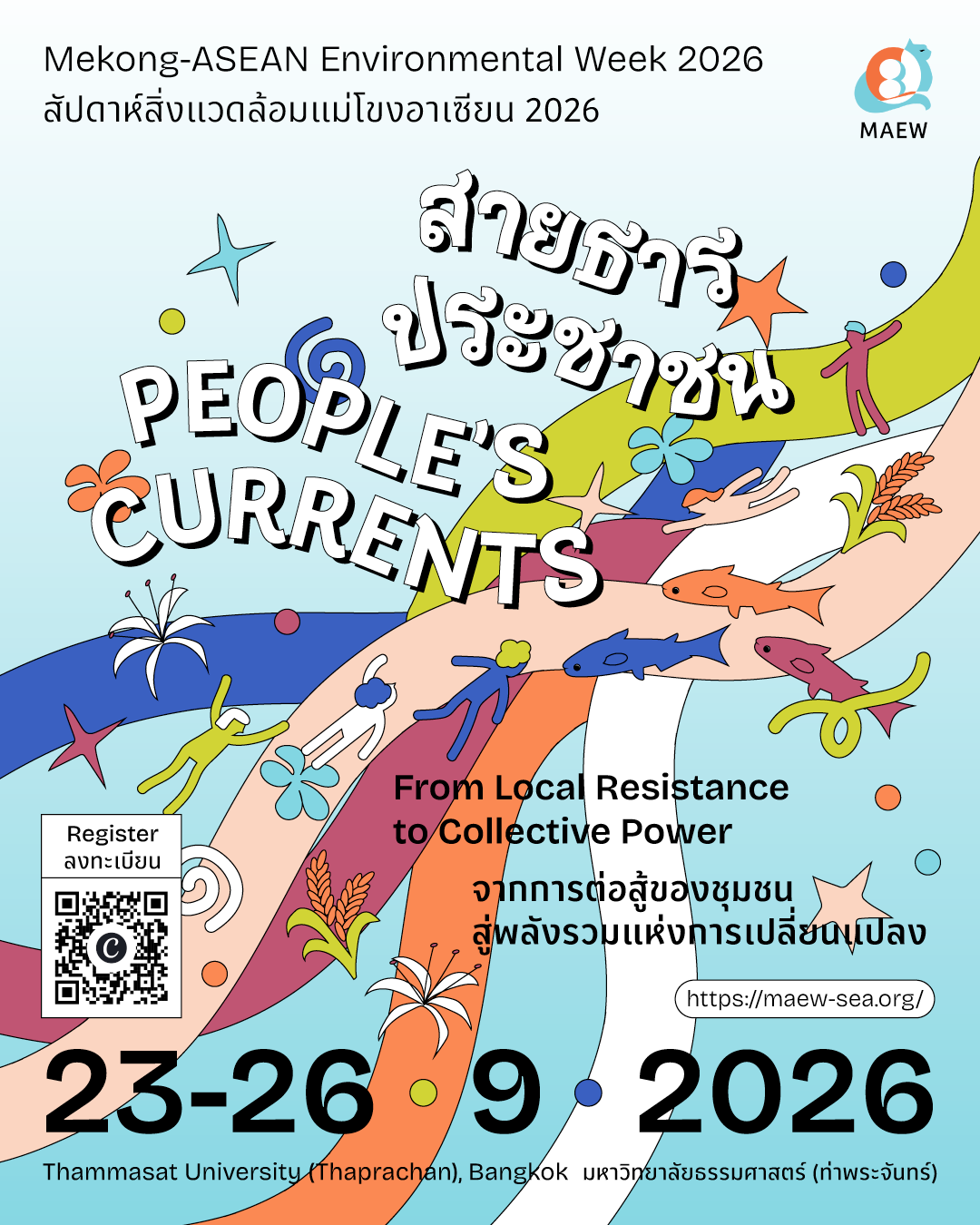
The Mekong–ASEAN Environmental Week (MAEW) is a regional platform for public exchange among civil society networks, diverse communities, academics, artists, youth, and social movements working across the Mekong region and Southeast Asia. Initiated by Project SEVANA Southeast Asia in 2019, MAEW has grown into an annual gathering that creates space for dialogue, learning, cultural exchange, and collective action around environmental justice and interconnected social issues.
The Mekong–ASEAN Environmental Week (MAEW) is a regional platform for public exchange among civil society networks, diverse communities, academics, artists, youth, and social movements working across the Mekong region and Southeast Asia. Initiated by Project SEVANA Southeast Asia in 2019, MAEW has grown into an annual gathering that creates space for dialogue, learning, cultural exchange, and collective action around environmental justice and interconnected social issues.
Events
Filter Events
{{ filteredEventsForView.length }} Events
Filter Events
{{ filteredEventsForView.length }} Events
At PO 103 Room, 1st Floor, Faculty of Political Science
[by Radical Grandma Collective, Restorative Culture Coalition Thailand, Hom Dok Hung Rice Agroecology Network, Sakon Nakhon Province, Project SEVANA South-East Asia, EnLaw Foundation, Rivers and Rights, Alternative Agriculture Foundation]
Mapping Currents of Healing: asked participants to surface 1) what needs to be restored, 2) the strengths and resources already present in each place, and 3) priorities for collective network action. This session is an interactive means to take the lessons learned in the dialogue and move them to action.
--- Grounding — Rotating Community Presentations- Rapid Round
--- Cross-Community Breakouts — Exchanging Ideas & Resources
--- Cross-Group Exchange — How Communities Exchange With Each Other
--- Collective Action Planning
Full details at https://drive.google.com/file/d/18KZIeOxPHaWuBvNXueSeFyKHMybseGGx/view?usp=sharing
At Main Meeting Room, 4th Floor, Faculty of Sociology and Anthropology
[by Phanom Nakhon Rama, Decode]
The Mekong-ASEAN Documentary Film Week 2026 uses documentary films, animations, and post-screening dialogues to create spaces for learning, reflection, and exchange among filmmakers, affected communities, and audiences. Each day's program explores a different theme while contributing to the broader vision of People's Currents, highlighting how stories from communities can inspire understanding, solidarity, and collective action. At least one screening will feature films produced through the Mekong Youth Lab, showcasing young people's perspectives and stories from across the region.
One film screening will be held each day throughout 23–26 September 2026, for a total of four screening programs.
Each program includes a documentary film or animation, followed by a Post-Screening Dialogue with filmmakers, community representatives, or invited speakers. While each day focuses on a different theme, all programs are connected through the overarching theme of People's Currents and the power of people's stories to inspire change.
At Room F406, 60th Anniversary Building, Faculty of Journalism and Mass Communication
[by Ecocupid]
This workshop uses a board game as a tool for learning environmental storytelling. Participants will explore how to portray themselves, their organizations, or their missions as characters and plots to achieve environmental media.
Participants will work in small groups of 3–4 people and experience a storytelling workshop through a board game.
The workshop will be conducted in English.
Expected participants: 20 people who lead their own organizations.
Room F408, 60th Anniversary Building, Faculty of Journalism and Mass Communication
This exhibition presents literary works and creative non-fiction produced by participants of the Mekong Youth Lab, developed through field-based learning with communities along the Mekong and Mun Rivers in Ubon Ratchathani Province.
Through stories of food, fish, riverside plants, fishing traditions, and community memories, the exhibition reflects on the changing relationships between people and rivers, while exploring the impacts of dams, large-scale development projects, and the gradual loss of ecological abundance. Using literature as a form of storytelling, the exhibition connects personal experiences with broader questions of environmental justice, food sovereignty, and social change.
At PO 103 Room, 1st Floor, Faculty of Political Science
[by Gen 4 Team, Sripatum University Khon Kaen Campus (Performing Arts Program), Mekong Youth Lab / Mekong Field Lab, Project SEVANA South-East Asia]
Developed through the Mekong Youth Lab, Order from the Past is a 15-minute performance inspired by field-based learning with communities in Ubon Ratchathani Province. Combining physical theatre and surreal storytelling, the performance explores the impacts of ecological change in the Mekong River on food sovereignty, cultural memory, and community life.
Set in the year 2126, the story imagines a future where food exists only as synthetic capsules, contrasting sharply with memories of a once-abundant Mekong rich in local food, knowledge, and traditions. Through symbolic imagery, the performance invites audiences to reflect on what may be lost if rivers, ecosystems, and community ways of life are no longer protected.
The performance combines movement, music, sound, and visual symbolism to tell the story of the Mekong across time.
A Post-performance Dialogue (20 minutes) will follow, bringing together performers, community representatives, and audiences to reflect on the connections between rivers, food systems, ecological change, and the future of the Mekong. The discussion also encourages participants to continue exploring related works presented as part of the Mekong Youth Lab.
Over four days, MAEW 2026 has brought together communities, youth, academics, artists, civil society organizations, and international partners to exchange experiences, examine shared challenges, and imagine alternative futures for the Mekong region.
Rather than concluding with a declaration or formal statement, the People's Assembly creates a space for participants to reflect on what they have learned, the relationships they have built, and the commitments they will carry forward. It is an invitation to continue the journey beyond MAEW, recognizing that meaningful change grows through diverse actions connected by trust, solidarity, and collective responsibility.
The assembly concludes with the voices of two community representatives, who will each share a brief reflection or commitment on what they will continue after returning home.
Rather than closing with a declaration, the moderator will offer “An Invitation to Continue”, reaffirming that MAEW does not end when the gathering concludes, but continues through every community, every river, and every action taken by people working together to shape the future of the region.
At Pridi Banomyong Courtyard
[by Alternative Agriculture Network (AAN), AgroEcology Foundation, Sustainable Agriculture Foundation Thailand, Food for Change, Towards Organic Asia (TOA), Project SEVANA South-East Asia]
Food systems are more than food production. They are deeply connected to biodiversity, farmers' rights, local knowledge, and community stewardship of natural resources. Across Thailand and the Mekong region, communities continue to protect traditional food systems and local seed diversity while responding to the challenges of climate change, development policies, agricultural technologies, and trade agreements.
The People's Food Sovereignty Market creates a learning space throughout MAEW 2026, bringing together farmers, community networks, consumers, and visitors through local food, seeds, stories, and diverse food cultures. The market demonstrates how food sovereignty is rooted in community knowledge, biodiversity, and people's collective management of land and natural resources.
The People's Food Sovereignty Market will be open throughout MAEW 2026 as both a community marketplace and the main dining space for participants. Meals will be prepared and served by participating community networks, allowing participants to experience diverse local food traditions from across Thailand and the Mekong region. A meal coupon system will enable participants to choose food from different community stalls, encouraging interaction with local producers while supporting community-led food systems.
The market also includes a range of interactive learning activities:
People's Food Market – Local food, seeds, agricultural products, and community-made goods accompanied by stories from participating communities.
Food Ecology Mapping – A collaborative display highlighting local food systems, seed diversity, and community resource management across Thailand and the Mekong region.
Learning Market – Food demonstrations, ingredient sharing, storytelling, and informal learning activities with participating communities.
Market Talks – Informal conversations featuring community representatives from different regions, including Northern Thailand, Northeastern Thailand, Eastern Thailand, Central Thailand, Southern Thailand, and the Mekong region, sharing experiences on local food systems, biodiversity, and community resource management.
Through these activities, the People's Food Sovereignty Market provides a space for farmers, community leaders, researchers, civil society networks, and MAEW participants to exchange knowledge, strengthen collaboration, and explore community-led approaches to protecting food systems, biodiversity, and food sovereignty.
Stay up to date
Get occasional email updates from MAEW 2026. Nothing else, and you can stop any time.
At most one email every few days, only when there is something new. The schedule will see the name and email you enter here. We never sell or share them, and every email has an unsubscribe link. Privacy Policy
Confirming also sets up an account for you, so everything you follow is in one place.